Open topic with navigation
Creating Collections
Collections can be created in two ways:
- Using the Search tab, perform a search, and create a collection with the results
- Using an import file
Regardless of how they are created, if a collection contains less than 10,000 objects, these can be inspected in the Tree hierarchy by expanding the Collection node. The collection will be displayed in an entirely flat structure regardless of any parent-child relations that may exist between the objects, and regardless of which parents / children the objects have when viewed elsewhere in STEP.
Creating a Collection from Search
The most common way to create a collection is through creating a search. To do so, follow the steps below.
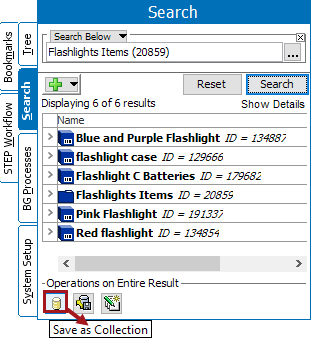
- Navigate to the Search tab, enter in the needed search criteria, and click Search to verify the results. For more on how to search, see the Navigation and Searches topic in the STEP User Guide / Getting Started documentation here.
- Click the 'Save as Collection' button.
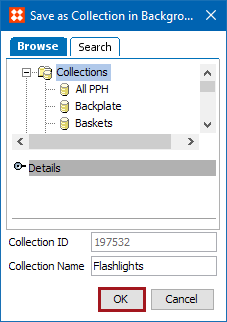
- Next select the appropriate parent in the collections hierarchy (either the top collections folder itself, or a collections group folder), enter a collection name (the ID is autogenerated), and click OK.
- A background process will run, and the new collection will be created and saved under the specified folder.
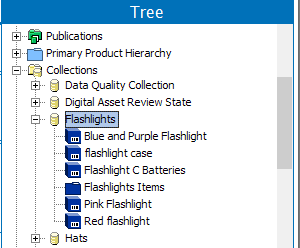
- A user can now right-click the collection, and run any needed bulk update, or export the objects.
Note: The initial search criteria used to locate the included objects, is stored on the collection, which allows for later updates of the collection. To learn more about editing searches to update collections see the Maintaining Collections topic in this documentation here.
Creating a Collection from File Import
Collections can be created from a text or CSV import file containing separated STEP IDs of products, assets, or classifications. Objects in the import file must already exist in STEP as the import will not create or update objects, only place them in a collection.
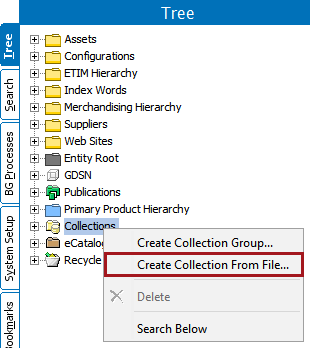
- To create the import, right-click the Collection top node or a collection group to determine where the new collection will live under. Then select Create Collection From File...
- In the Create Collection From File dialog, locate the file to be imported.
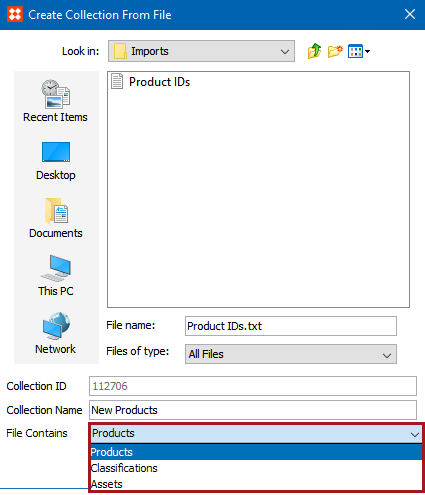
- For the Collection Name parameter, add a Name for the new collection (IDs are autogenerated).
- For the File Contains parameter, select if the import file contains IDs of products, assets, or classifications.
- Click OK to start a background process which will create the new collection.
2018, Stibo Systems