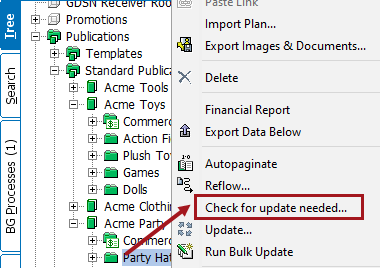
One advantage of using STEP AutoPage to automate page building is the ability to automatically update the contents of previously built pages without having to rebuild them from scratch.
When pages are built (mounted) using AutoPage, the content placed from STEP onto the pages accurately reflects how the content existed in STEP at that moment in time. If changes are made later to the corresponding content in STEP (for example, attributes values or referenced images), the pages become out of sync with the latest content.
When this content mismatch occurs, there are several options available within STEP'n'design and STEP Workbench for updating page contents. This topic describes how to use the update options available for AutoPage from within the workbench. Methods for updating pages from within InDesign are explained in the Updating Documents From InDesign topic here.
Though it is possible to update the contents of entire publications and sections at once without first checking to see exactly what pages or mounted objects contain outdated content, AutoPage provides functionality that gives visibility into the specific locations of content that needs updating. Pinpointing the exact location(s) of this content allows for smaller page update operations, preventing scenarios where a large amount of system resources are tied up for large update operations (for example, on entire publications) when only one section or even one document may actually need updating.
Documents can be checked for needed updates from the Tree, the AutoPage Publication Planner, and by using a Bulk Update operation.
Important: Only content updates are recognized by the system. Template changes or pagination rule changes are not shown as updates needed on the Page Inspector tab or AutoPage Publication Planner tab.
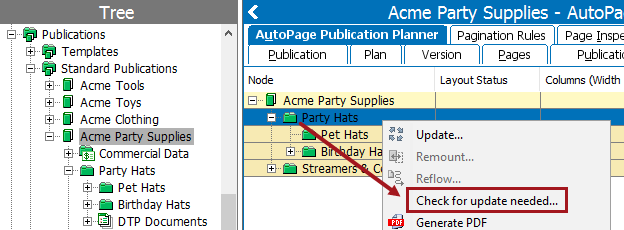
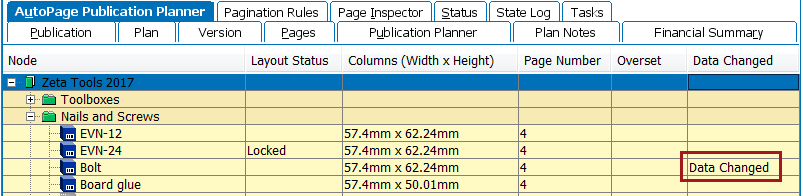
Documents can be checked for updates by running the bulk update operation 'Check publication document for needs update.' This operation is accessed in step 2 of the bulk update wizard ('Operations').
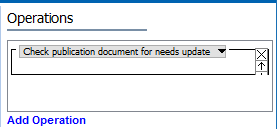
Checking for updates from the bulk update wizard is, for all intents and purposes, identical to checking for updates from the two previously documented methods in this topic. (It is essentially the same functionality, just accessed from a different location.)
For information on how to access and use bulk update publishing operations, see Publishing Operations for Bulk Updates in the Getting Started / STEP User Guide documentation
Mounted (actual) pages saved back to STEP can be updated from the Tree by the following methods for users of any STEP Publisher license: Update and Bulk Update. Both methods work in a near-identical fashion, but Update is the simplest and most straightforward. In AutoPage, documents—and even individual mounted objects themselves—can be updated from the AutoPage Publication Planner.
The Update feature is accessed by right-clicking on a publication, section, or DTP document object in the publication hierarchy.
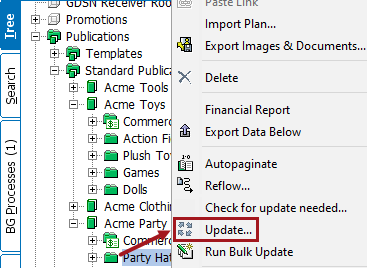
Since 'Update' is valid for any STEP publishing component (as long as an InDesign server [IDS] is set up and integrated with the STEP application server), this functionality is detailed in the Updating Documents in the Workbench section of the STEP'n'design documentation
Note: If you select Object Name, all product, classification, attribute, section, and subsection names are updated. If a Repeat rule is applied to a section, but you only selected one page within this section to be updated, the section name is not updated outside of the selected page.
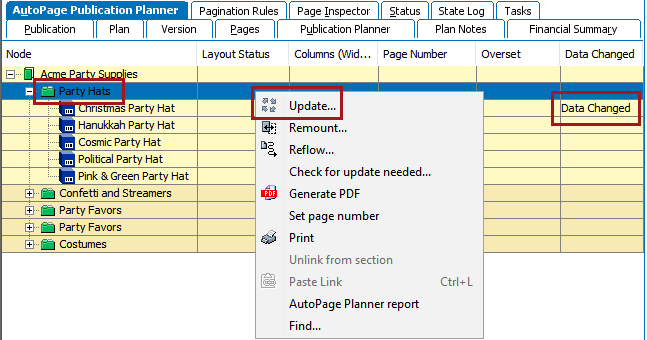
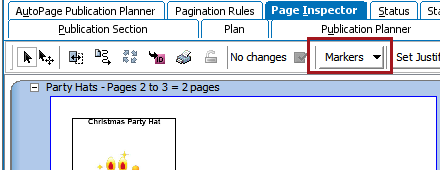
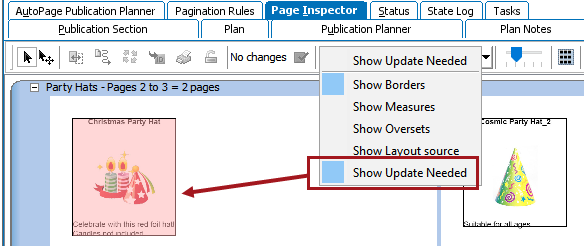
Once documents have been checked for needed updates, the AutoPage Page Inspector provides a visual indicator to let you know if an update needs to be run on a mounted object or page.
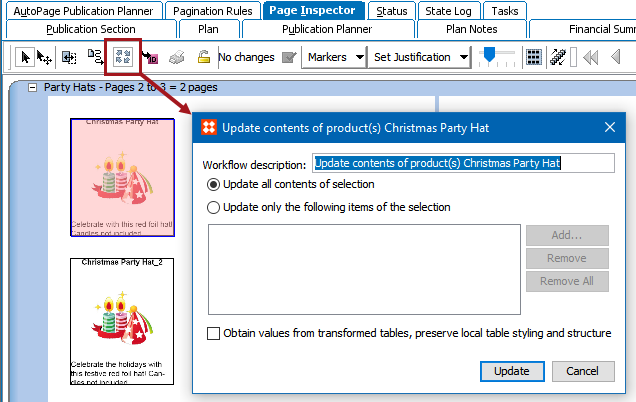
Bulk update is simply another method of accessing the same features available under 'Update'. For information on bulk update operations for STEP publication documents, see Publishing Operations for Bulk Updates in the Getting Started / STEP User Guide documentation
2017, Stibo Systems