As defined in the following sections, a match and merge solution communicates with external systems using either an asynchronous IIEP or a synchronous web service setup.
This functionality is used by a Match and Merge solution. For more information, see the Match and Merge topic (here) and the Configuring Match and Merge topic (here).
Asynchronous Merge Inbound Integration Endpoint
When match and merge is set up as a data hub, the data can flow into STEP via an asynchronous inbound integration endpoint (IIEP).
During an import, source records listed in the imported file are created and treated as temporary STEP objects. Despite their temporary nature, business rules can act on them, and they can be matched via a matching algorithm. When being matched, survivorship rules determine which (if any) source values get promoted to existing golden records. After the import process is complete, these temporary objects are discarded.
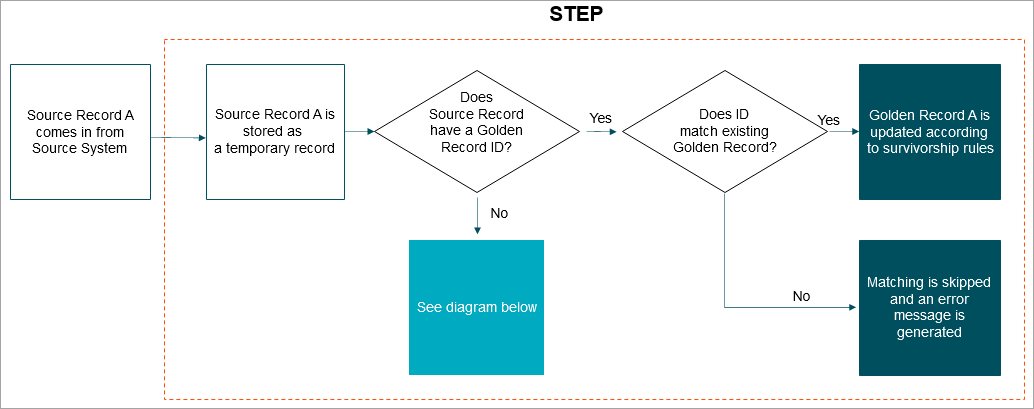
Imported data is processed in the following order:
- The IIEP checks the temporary source record to see if it has a known golden record ID. If it does have an ID, then the corresponding golden record in STEP is updated based on the survivorship rules configured in the matching algorithm. If no existing golden record shares the same ID, then the source record is ignored and is not imported to a golden record. A relevant error message is provided.
- The IIEP checks the temporary source record to see if it has a known source record ID. If an existing active (not deactivated) golden record is found that has the same source ID, survivorship rules are applied to promote source values to the golden record.
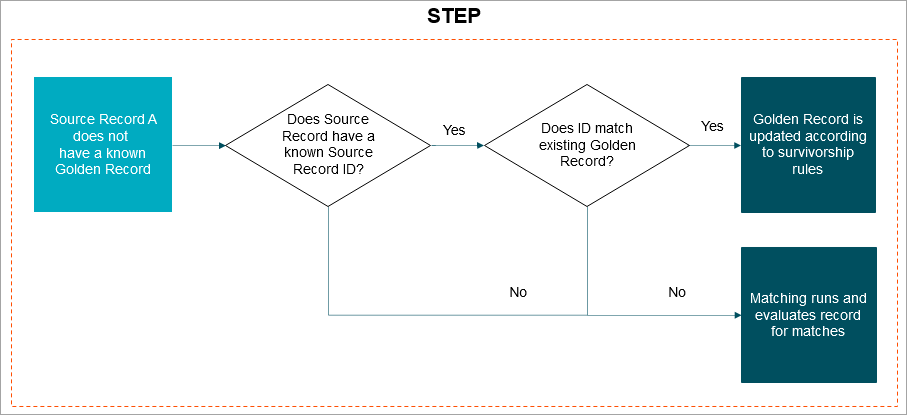
- If neither a golden record ID nor source record ID is found, the configured matching algorithm is invoked and matches the temporary source records to existing golden records in STEP. If a source record matches one or more golden records above the auto threshold, then survivorship rules are applied to promote source values to the golden record that is selected by the match criteria match rules. If multiple golden records match above the auto threshold, those existing golden records are not merged in this process. Temporary source records that are matched below the auto threshold become their own golden records.
Note: Because the imported records are temporary STEP objects, all elements of matching must be prepared to run before references to other objects are created. You cannot query for 'references to' or 'references from' on temporary STEP objects. Furthermore, the match codes can only depend on values on the current object and survivorship rules only update values the current object.
For configuration details, see the Match and Merge IIEP Configuration section of the IIEP - Configure Match and Merge Importer Processing Engine topic in the Data Exchange documentation here.
Synchronous Match and Merge Web Service Endpoint
The match and merge synchronous web service endpoint is an alternative to the asynchronous IIEP. It delivers an answer to each request, alerting the external system to the result of the match and merge operation.
The request sent to this service includes the following information:
- User name and password for access validation.
- A reference to a STEP context.
- A reference to a STEP Match and Merge web service endpoint.
- Entity representations of each record to be imported. Non-duplicates can be declared via the non-duplicate reference types, as defined by the matching component model.
The web service receives a request and completes the following process on incoming data:
- Validation - Ensures minimum data requirements are satisfied (e.g., record has an address or a last name). Records that are not successfully validated are rejected and not stored in STEP.
- Standardization - Standardizes data based on the configuration (e.g., address standardization).
- Matching - Identifies existing record matches and potential record matches. The outcome is one of the following:
- new or updated golden records in STEP
- rejection from the web service
In all cases the web service response includes if:
- the incoming record was validated.
- any potential duplicates were found.
- there is new / updated information on the record itself.
- the record will be handled manually in a clerical review workflow.
Note: The exact behavior of a match and merge web service endpoint depends on the endpoint configuration.
The following topics include more information on: