A number of configuration options are available for each view, allowing them to be tailored for more efficient use. These content elements determine which columns display in each view, except for Sticker Book, where these elements display in a vertical list on each Flatplanner frame. The view elements described in this topic can be configured in the following areas of the Flatplanner interface in the STEP Workbench:
Note: The Publication Planner also uses a view, but it has a different set of view elements. For more information on the view options available for the Publication Planner, see the Configuring the Publication Planner Column View topic in this guide here.
The following subsections describe the available View element options.
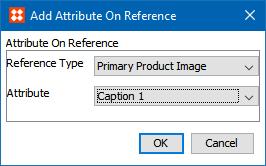
Displays the value of a description attribute that is valid on the specified reference link type. For example, this element could be used to display a caption for an image that is linked to a product in a basket. The caption attribute would exist on the link between the product and the image.
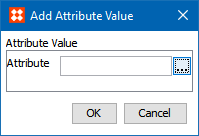
Displays the value of a specified attribute or attributes.
 ) , then browse to or search for the preferred attribute in the 'Select Object' dialog (not pictured). Multiple attributes can be selected by holding the Ctrl or Shift key while making selections.
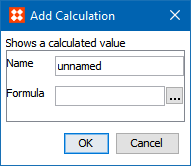
Displays the value of a specified STEP Function. One example could be a calculation that concatenates the values of multiple commercial terms lists along with free text descriptors. For example, text such as 'Qty. on hand' or 'Qty. on order' could be concatenated along with corresponding commercial terms values.
) next to the Formula field to launch the Function Editor (not pictured).
For detailed information about calculations and how to specify functions, see the STEP Functions section of the Resource Materials online help documentation here.
Displays the specified value from a commercial terms list type.
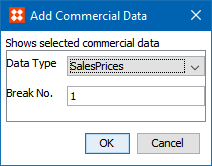
Multiple term values from the same list type, e.g. price breaks that correlate to different quantities, can be added to the view by adding the same list type again, then adding a different break number.
For detailed information on commercial data, see the Commercial Data section of the STEP Publisher (InDesign) documentation here.
Displays the object's STEP ID in the view.
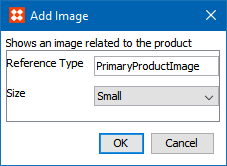
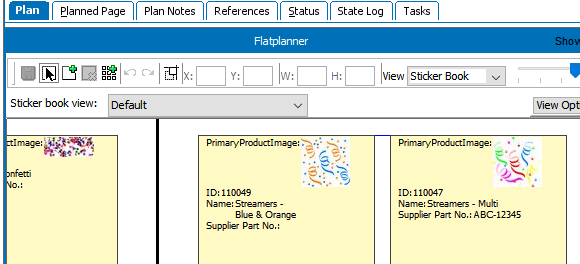
Displays a thumbnail of a linked image.
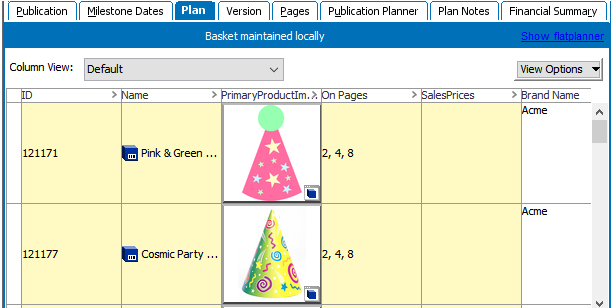
In the Flatplanner Basket, Normal and Small images display as follows:
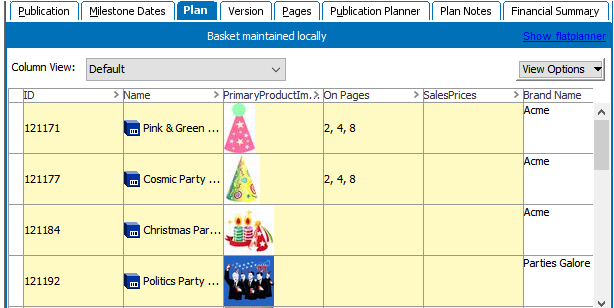
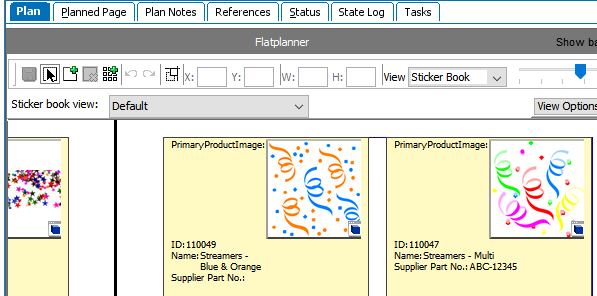
In the Flatplanner Sticker Book view, Normal and Small images display as follows:
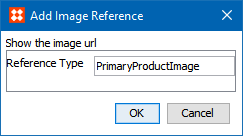
Displays the STEP URL of a linked asset. Typically, the asset reference type entered for this element will be the same as the one used for the Image element.
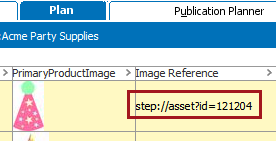
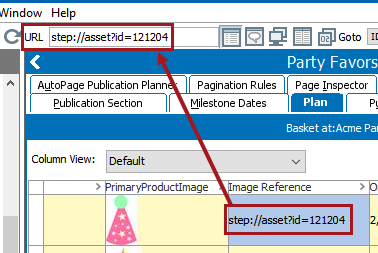
Tip: Though the URL is not hyperlinked in the view, the URL can be copied to the clipboard by selecting the cell in the basket and pressing Ctrl+C (Cmd+C on Mac systems). The URL can then be pasted into the STEP URL field by pressing Ctrl+V (Cmd+V on Mac systems).
Displays the object's STEP Name in the view.
Displays the page number(s) of the Flatplanner planned page(s) to which the object has been linked in the publication.
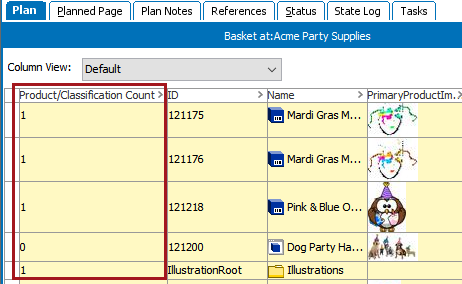
Displays the number of products or classifications in a view column. The number displayed is 1 for product and classification objects and 0 for asset objects.
Displays the amount of space, in square millimeters, that the object occupies on actual pages (InDesign documents) saved back to the publication in STEP.
2018, Stibo Systems – Confidential