The Global Data Synchronization Network (GDSN) is an internet-based global network and global registry that enables secure and continuous data synchronization between one or more trading partners. This connection is made via a network of interoperable GS1-certified data pools.
GS1 is an international organization that develops and maintains the GDSN standards.
A company can both be a provider of a data pool and a subscriber to a data pool. When a company make changes to a data pool, the changes are automatically available to all subscribing trading partners.
By subscribing to data pools, you can reduce the time you would otherwise spend on manually entering and maintaining information.
To synchronize data it is necessary to use a common standard to exchange information about products. This standard includes product and location information.
Within GDSN, trade items are identified using target markets and a unique combination of the GS1 Identification Keys called Global Trade Item Numbers (GTIN) and Global Location Numbers (GLN).
Product information includes: Item attributes controlled by the data provider including Global Trade Item Number (GTIN), size, weight, height, brand, and UPC code.
Location information includes: Global Location Number (GLN), locations such as company headquarters, billing departments, and ship-to addresses.
GS1-certified data pools are electronic catalogs of standardized item data. They serve as a source and/or a recipient of master data.
The GS1 Global Registry is the information directory of GDSN that holds the registered items. If subscription criteria match an item, the data provider’s data pool is informed, and the synchronization of product data begins.
GS1-certified data pools such as 1SYNC are electronic catalogs of standardized item data. They serve as a source and/or a recipient of master data.
This guide contains information about how to setup GDSN data pools and use data pools in order to receive data from different data providers.
The guide assumes that:
GDSN works together with data pools in the following way:
|
Standard |
Description |
|---|---|
|
GTIN |
Global Trade Item Number - a global identification number that can be used by a company to uniquely identify trade items. Trade items are defined as products or services. |
|
GLN |
Global Location Number - a unique, 13-digit identification number. The GLN can be used to identify a company's physical location and to identify corporate entities as well as a company's legal and functional entities. Each data provider and each data recipient has their own unique GLN that is used when publishing and subscribing for data. |
|
GPC |
Global Product Classification - used by GS1 to ensure that products are classified correctly and uniformly, and is a system that gives data providers and data recipients a common language for grouping products in the same way everywhere in the world. |
|
Term |
Description |
|---|---|
|
CIS |
Catalogue Item Subscription - subscription sent by a data receiver requesting data. |
|
CIN |
Catalogue Item Notification - notification to a data receiver. The CIN includes the requested product data. |
|
CIC |
Catalogue Item Confirmation - confirmation response returned to the data provider by a data receiver. |
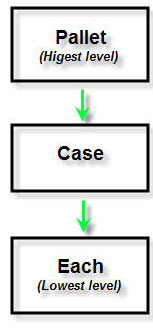
The trade item hierarchy - or the packaging hierarchy - describes the relationship between trade items that contain other trade items, and it describes on which level in the hierarchy each item fits in. A trade item can, for example, belong to one of the following levels: base unit (Each), case, and pallet. Regardless of how many levels are in a hierarchy, the final level must be a base unit.
A parent item is an item that contains lower level trade items (children) in a packaging hierarchy. A child item is an item with a higher level trade item (parent) in a packaging hierarchy. A child item can have multiple parents, and it can therefore be included in many packaging hierarchies.
You can view the packaging hierarchy data from the Packaging Hierarchy tab in STEP.
2018, Stibo Systems – Confidential