Each hierarchy created in the database is defined with a specific structure in mind. Each hierarchy node within each level is assigned an Object Type. The manner in which the hierarchy is structured determines what Object Types that can be assigned to the nodes in each level.
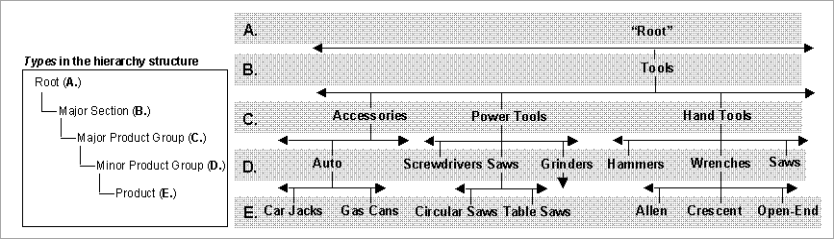
For example, the diagram below shows a fixed (rigid) hierarchy, where all Products have been categorized into four levels (not counting the top or root level). This structure means that all Products, regardless of what type of Product, must fall into this four-tier categorization.
In this example, all the nodes in each level of the hierarchy will have the same Object Type. The overall effect of this type of setup is that each level has been assigned a different Object Type. So, any hierarchy node residing in the specified gray area is of the Object Type that has been assigned to that level.
In this example, the 'Screwdrivers' node is of the Object Type called 'Minor Product Group' and the 'Table Saws' node has been given 'Product' as its Object Type. In the hierarchy structure, then, the setup is such that there is a fixed number of levels, and that at each level there is only one 'child' Object Type. For example, the only child of 'Major Product Group' is the one called 'Minor Product Group'.